
The Central Commission for Control and Inspection: Open Sectarian Discrimination, Assaults on Alawite Inspectors, and Humiliation
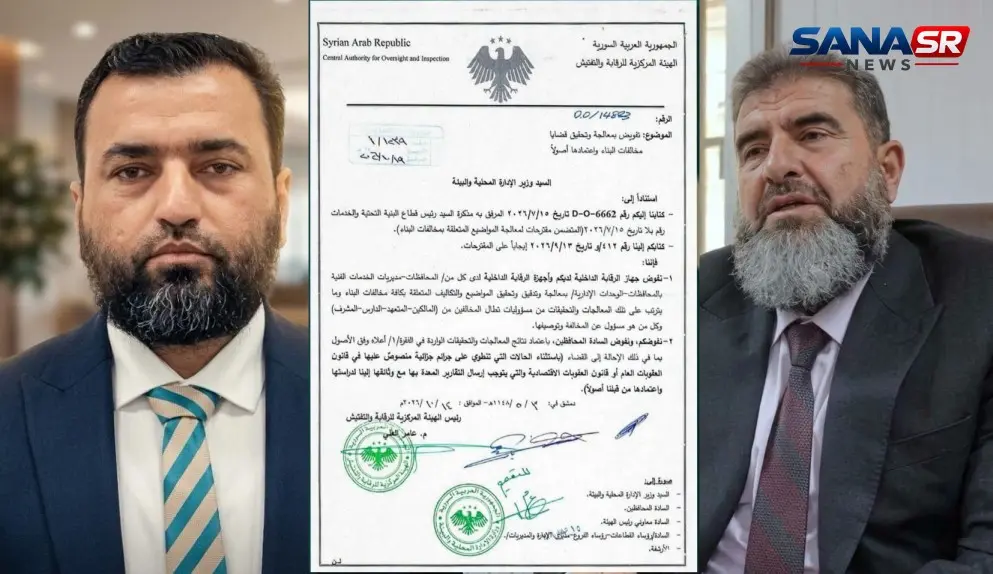
The reality of work within the Central Commission for Control and Inspection and its branches across the governorates, particularly in the Homs branch, is witnessing a series of serious legal and administrative violations that have affected the core of the inspection apparatus under the de facto authorities. Foremost among these violations is systematic exclusion on a sectarian basis, which has resulted in approximately 300 inspectors across the Commission in Syria being placed on compulsory paid leave. Approximately 98% to 99% of them belong to the Alawite sect, under the pretext of corruption allegations unsupported by documented legal evidence, while the real reason is purely sectarian.
First: Legal Violations in Implementing Decisions on Paid Leave and Reducing Salaries
Violation of the decision of the so-called Presidency of the Republic:
A decision was issued by the so-called General Secretariat of the Presidency of the Republic on 28-8-2025, stipulating that all employees granted paid leave in all public entities must return to their workplaces. While all state entities implemented the decision, the Commission’s leadership repeatedly extended the leaves (one month, then another month), before completely ceasing to take any action and leaving the employees at the disposal of the Commission’s president, without work and without a clear legal extension.
Violation of the salary and wage scale:
Inspectors granted paid leave were subjected to an arbitrary measure stipulating that their salaries be set at only one million Syrian pounds per person, while an employee actively working at the Commission receives three million Syrian pounds (equivalent to the salaries of three inspectors on paid leave). This measure constitutes a blatant violation of the Basic Law for State Employees and the applicable salary and wage scale, in addition to depriving them of the general 50% increase, the special increase, and all other financial benefits.
Second: Systematic Exclusion, Sectarian Discrimination, and Psychological and Physical Pressure (The Homs Branch as a Case Study)
Following the appointment of Inspector Abdul Fattah Al-Attar as head of the Commission’s Homs branch, with the endorsement of Deputy Yasser Al-Hussein, a clear campaign of targeting began against a number of qualified inspection and administrative personnel from the Alawite sect. They were summoned and given the choice between submitting their resignations or being referred to the General Security Directorate.
Names of those targeted and forced to resign:
- Hasem Ibrahim
- Idris Idris
- Yousef Mehrez
- Ahmad Al-Deeb
- Shireen Younes
- Zein Al-Abidin Mohammad
- Malek Rabee
- Nermin Mohammad
- Administrative employee Mohammad Al-Mohammad
Coercion and physical assault:
When Inspector Malek Rabee refused to submit his resignation, the Internal Security Directorate was informed. It sent him a text message instructing him to report to them, where he was subjected to beatings, insults, humiliation, and threats to target his family (his wife and children). This led to him being forcibly compelled to submit his resignation under the pressure of threats.
Background and Parties Involved in the Decision
The available information pointed to the current role of Inspector Lina Wazir (from the town of Kafr Aya), who was corrupt and wrote reports against her colleagues with the support of Major Satouf Al-Freij at the former Political Security Branch in Homs, in order to eliminate fellow inspectors who did not align with her, amid the inability or complicity of the branch head at the time.
Third: Structural and Administrative Violations and the Blatant Legal Breach by the Commission’s Leadership
Violation of the conditions for assuming the Commission’s presidency and the issuance of an invalid delegation letter:
The law stipulates that the head of the Commission must be a judge, whereas the position is currently held by engineer Amer Al-Ali (a graduate in mechanical engineering), meaning that his decisions lack legal and administrative expertise.
A serious legal violation:
The Commission’s president, Eng. Amer Al-Ali, issued letter No. (00/14823), dated 12/10/2026, addressed to the Minister of Local Administration and Environment. The letter delegates all investigative procedures and adjudication of building violation cases to the internal oversight bodies within the governorates, allowing them to refer such cases directly to the judiciary without the reports being approved by the Central Commission for Control and Inspection.
The nature of the legal violation:
This decision constitutes a precedent and a serious تجاوز of the Commission’s law, as it allows an internal inspector (who is administratively subordinate to the head of the entity or the governor) to investigate their own superior, thereby granting directors and officials immunity from accountability and preventing them from being held responsible for violations. Furthermore, investigations into building violations are governed exclusively by Decrees No. 50 of 2008 and No. 48 of 2012, rather than the Economic Penal Code. This effectively empties the inspection system of its role and allows violations to pass without independent oversight. His role is also limited to unproductive meetings, while assigning the executive tasks to his deputy, Yasser Al-Hussein.
Establishing the “Inspection Institute” and draining public funds:
Deputy Yasser Al-Hussein abolished the “Directorate of Qualification and Training” (in a step contrary to the Commission’s law and internal regulations) and replaced it with what is called the “Inspection Institute” in Damascus and Aleppo.
The institute’s objective:
To prepare new inspectors based on loyalties (most of them from Idlib Governorate, including individuals with recent combat backgrounds who have recently graduated and lack sufficient experience).
Financial cost:
Houses are being rented and cars have been allocated to accommodate and serve them at the expense of the state treasury, so that they can work in place of the original experienced inspection personnel who have been displaced through paid leave and forced resignations.
Fourth: Conclusion and Demands
These circumstances reveal an administrative restructuring process of a narrow sectarian and regional nature within the Central Commission for Control and Inspection, involving methods of intimidation and pressure outside the framework of the Constitution and applicable laws (such as the Basic Law for State Employees). This calls for serious intervention to correct the legal course, hold those responsible for violations accountable, and restore the rights and legal status of the affected inspectors.
What is the legal fate of hundreds of inspectors and administrative employees left in limbo under arbitrary “paid leave” on a sectarian basis…?
It should be noted that what is happening within the Commission applies to most public entities in Syria that exhibit sectarianism and similar treatment. The Central Commission for Control and Inspection is the example: if this is how things are there, what do you think the situation is like in other institutions…?